Low Wood Bay Resort & Spa

Tour de France 2027 Stage 2: Keswick to Liverpool

Saturday 3rd July 2027 will see Stage 2 of the Tour de France 'Grand Depart' race from Keswick to Liverpool.

Telephone bookings:
0333 2203 108
Mon to Fri: 8:30am - 8pm Sat/Sun: 8.30am - 4pm

Stage 2 of the 2027 Tour de France is a 223 km hilly stage from Keswick in the Lake District to Liverpool, held on Saturday 3 July 2027. It is the second day of the British Grand Départ and includes five categorised climbs, all of them short, through the Lake District and the Lancashire hills. The stage finishes on The Strand beside Liverpool's Royal Liver Building and the Three Graces.


Question
Answer
Date
Saturday 3 July 2027
Start
Keswick, Cumbria (Lake District National Park)
Finish
The Strand, Liverpool
Distance
223 km
Stage type
Hilly
Total climbing
About 2,800 - 3,000m
Categorised climbs
5
Highest named climb summit
Waddington Fell, around 352 m
Last categorised climb
Côte de Parbold, about 40 km from the finish
Stage before
Stage 1: Edinburgh to Carlisle (2 July)
Stage after
Stage 3: Welshpool to Cardiff (4 July)


Stage 2 Overview

Stage 2 is the longest stage of the 2027 Grand Départ. After a sprinter-friendly opening day from Edinburgh to Carlisle, it is the first real test of the peloton's legs. The race starts in Keswick, runs south along the lakes, follows the Morecambe Bay coast, and then climbs through the Forest of Bowland before heading across Lancashire and into the Liverpool City Region.

The climbs are short rather than severe, which makes this a stage that could suit either a breakaway or a reduced sprint. Because the last categorised climb is crested 40 km from the finish, riders who are dropped have time to chase back, and the run into Liverpool is expected to favour the fast finishers who survive the hills.
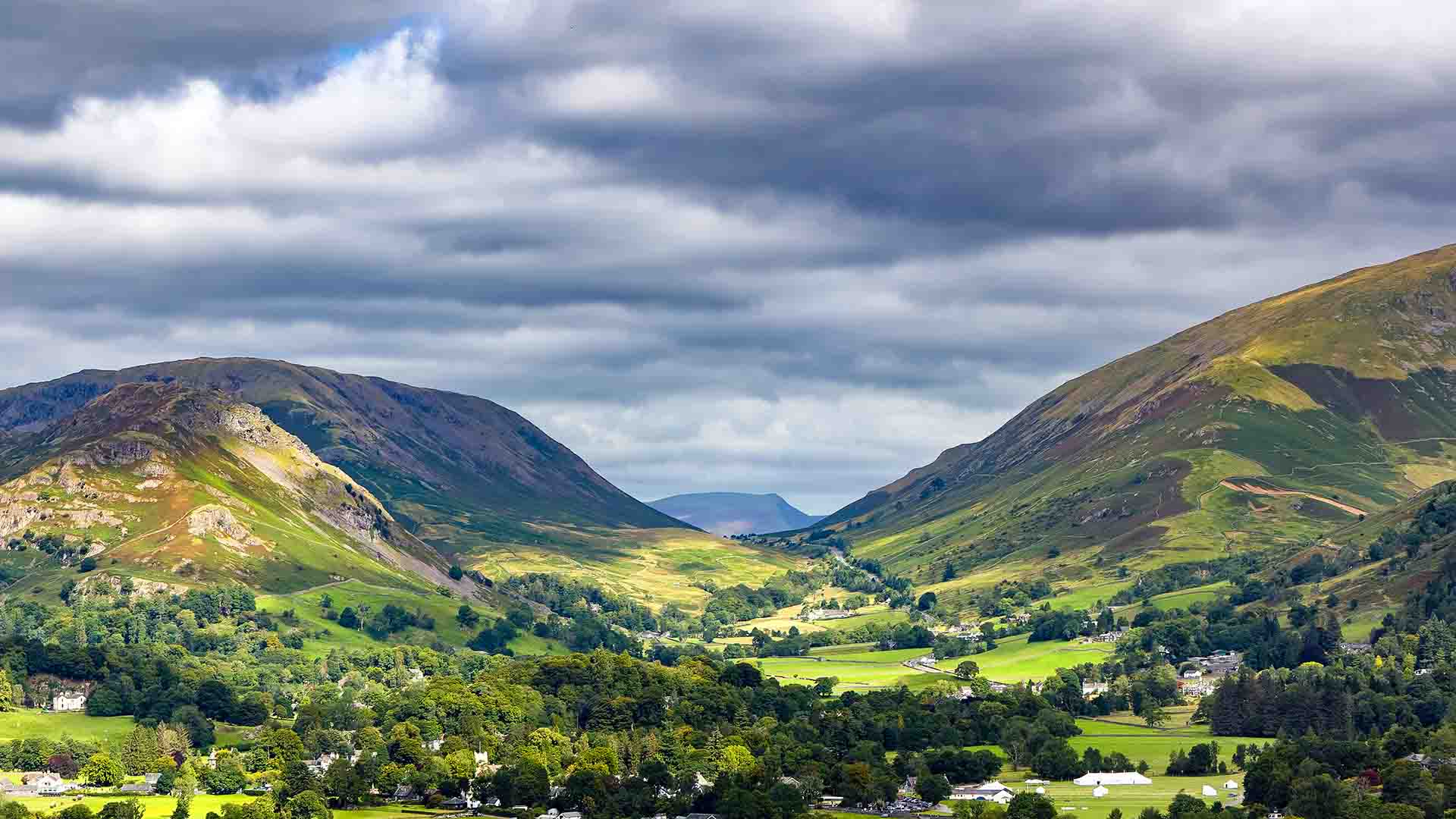
 

Dunmell Raise in the Lake District
The A591 and Dunmell Raise near Grasmere


Route map: Keswick to Liverpool

The route moves south through four distinct landscapes. In order, the main points of the route are:

  1. Keswick (start): the départ fictif is in this market town at the northern end of Derwent Water, with the départ réel on the outskirts of town.
  2. Thirlmere, Grasmere, Rydal Water and Ambleside: a run along the A591 through the heart of the Lake District.
  3. Windermere and Bowness-on-Windermere: the riders pass along the shore of England's largest natural lake.
  4. Milnthorpe, Carnforth and the Morecambe Bay coast: the terrain flattens as the route skirts the bay.
  5. Lancaster (around the 75 km mark): the route climbs away through Quernmore to the first categorised climb.
  6. Forest of Bowland: Côte de Jubilee Tower, Côte de Trough of Bowland and Côte de Waddington Fell, via Dunsop Bridge and Newton-in-Bowland.
  7. Clitheroe, Whalley and Blackburn: the route drops into the Ribble Valley and then heads into east Lancashire.
  8. Belmont and Chorley: Côte de Belmont, then a run past Rivington Reservoir and on to Chorley.
  9. Parbold: Côte de Parbold, the final categorised climb.
  10. Upholland, Prescot and Huyton: the approach into Merseyside.
  11. Liverpool: the route passes Sefton Park and Penny Lane, drops down Parliament Street and finishes on The Strand by the waterfront.


What to expect on Stage 2

The profile suggests two realistic scenarios. A breakaway that gets away in the hills of the Forest of Bowland could gather King of the Mountains points and try to hold on to Liverpool. Alternatively, the sprinters' teams may keep things together, expecting a reduced bunch sprint on the waterfront. Crosswinds in the open coastal and lowland sections could also split the peloton.


Where to watch

The Lake District start in Keswick, the climbs in the Forest of Bowland and the finish on Liverpool's waterfront are the standout vantage points. Roads will close, so check the official Tour de France Grand Départ 2027 website and your local council for road closures, timings and spectator guidance before you travel.


Low Wood Bay
The A591 as it passes Low Wood Bay Resort & Spa


Low Wood Bay is ideally positioned, by the A591, providing a prime location from which to view the race as it passes. Low Wood Bay Resort & Spa will be celebrating this fantastic event with special package offers and a host of themed menu offerings and events for guests to enjoy.

Frequently asked questions


When is Stage 2 of the 2027 Tour de France?

The date for Stage 2 of the 2027 Tour de France is Saturday 3 July 2027.

Which stages make up the 2027 Tour de France Grand Départ?

  • Stage 1: Edinburgh to Carlisle (2 July).
  • Stage 2: Keswick to Liverpool (3 July).
  • Stage 3: Welshpool to Cardiff (4 July).


Where does Stage 2 of the 2027 Tour de France start and finish?

Stage 2 of the 2027 Tour de France starts in Keswick, in the Lake District, and finishes on The Strand in Liverpool.

How long is Stage 2 of the 2027 Tour de France?

Stage 2 of the 2027 Tour de France is 223km (138 miles) long.

Is Stage 2 a sprint stage or a mountain stage?

Neither. It is classed as a hilly stage, with short climbs and a mostly flat run-in, so it could suit a breakaway or a reduced sprint.

What is the significance of named or categorised climbs?

Prominent hill-climbs on stages of The Tour de France are classified and prefixed with the name 'Cote de'. Points are attributed to the first few riders over the top of each named climb, with points counting towards the race's 'King of the Mountains' points jersey race.

How many climbs are on Stage 2?

There are five categorised climbs on Stage 2:


What are the Stage 2 named (categorised) climbs

Stage 2 has five categorised climbs, which also count towards the polka-dot jersey. Three of them come in quick succession in the Forest of Bowland, one comes after Blackburn, and one in the final third of the stage.

  1. Côte de Jubilee Tower
  2. Côte de Trough of Bowland
  3. Côte de Waddington Fell
  4. Côte de Belmont
  5. Côte de Parbold


1. Côte de Jubilee Tower

The first categorised climb of the day is Côte de Jubilee Tower, steep at the start and then more undulating as it rises. At 3.8km long and 6.1% on average, it is the longest of the stage's five climbs and an early chance to take King of the Mountains points. This popular category 3 hill climb ascends from the village of Quernmore and is named after the Jubilee Tower that sits towards the top of the climb on the fells above Lancaster.

  • The Côte de Jubilee Tower is 88 km (54 miles) into stage 2.
  • The climb reaches 285 metres (935 feet) above sea level.
  • The climb is 3.8km (2.36 miles) long.
  • The climb has an average gradient of 6.1% with a maximum gradient of 14-16%.


2. Côte de Trough of Bowland

The Trough of Bowland is a U-shaped valley in the Forest of Bowland. The climb is 1.9 km at 5.2% on average, followed by a descent to Dunsop Bridge. It is one of the area's best-known cycling roads.

  • The Côte de Trough of Bowland is 98.5 km (61.2 miles) into stage.
  • The climb reaches 293 metres (961 feet) above sea level.
  • The climb is 1.9km (1.18 miles) long.
  • The climb has an average gradient of 5.2% with a maximum gradient of 15-16%.


3. Côte de Waddington Fell

Waddington Fell is an area of high moorland, located between the Forest of Bowland and the Ribble Valley, near the village of Waddington and the historic market town of Clitheroe. The climb is the hardest of the stage's five climbs by average gradient, at 3.4 km and 6.4%. It is made up of several steep ramps with flatter sections between them. The summit, at the cattle grid, is about 352m. The descent towards Waddington is steep and signed at 13%, testing both a riders' bike handling and climbing ability.

  • The Côte de Waddington Fell is 112 km (69 miles) into stage 2.
  • The climb reaches 347 metres (1138 feet) above sea level 
  • The climb is 3.4km (2.11 miles) long
  • The climb has an average gradient of 6.4% with a maximum gradient of 13-20%.


4. Côte de Belmont

A gentler effort of 2.0km at 4% on average, climbing Rivington Road to Hordern Stoops at about 326m. The riders then descend to Rivington Reservoir.

  • The Côte de Belmont is 152.5 km (94.75 miles) into stage 2.
  • The climb reaches 326 metres (1069 feet) above sea level 
  • The climb is 2km (1.24 miles) long
  • The climb has an average gradient of 4%.


5. Côte de Parbold

The final categorised climb is 1.8 km at 5.6% on average, rising from Parbold along Sparrow Hill. It is crested about 40 km from the finish in Liverpool, which gives dropped riders time to rejoin the peloton.

  • The Côte de Parbold is 183 km (113.7 miles) into stage 2.
  • The climb reaches 122 metres (400 feet) above sea level 
  • The climb is 1.8km (1.11 miles) long
  • The climb has an average gradient of 5.6%.


Order
Climb
Length
Average gradient
Where
1
Côte de Jubilee Tower
3.8 km
6.1%
Above Quernmore, east of Lancaster
3
Côte de Trough of Bowland
1.9 km
5.2%
Forest of Bowland
4
Côte de Waddington Fell
3.4 km
6.4%
Between Newton-in-Bowland and Waddington
5
Côte de Waddington Fell
2.0 km
4.0%
Rivington Road, near Belmont
6
Côte de Parbold
1.8 km
5.6%
Sparrow Hill, Parbold


What do the different coloured jersey's at The Tour De France mean?

Four jerseys are worn in the Tour de France, and each tells you at a glance who is leading which competition. On Stage 2 the riders wearing them will be those who lead after Stage 1 into Carlisle.

  • Yellow is the most coveted. The rider in yellow after the final stage in Paris wins the Tour. The colour comes from the yellow paper of the newspaper L'Auto, which founded the race.
  • Green rewards consistency and speed. Points are given at stage finishes and at intermediate sprints, with the biggest rewards for flat stages.
  • Polka-dot is decided by points on the categorised climbs. Stage 2 has five, so the jersey could change hands early in the race.
  • White is worn by the best-placed young rider and is often a sign of a future overall contender.

There is also a daily most combative rider award, marked by a red race number the next day.

Jersey
What it means
Yellow (maillot jaune)
Overall leader on time (general classification)
Green (maillot vert)
Leader of the points classification
Polka-dot (maillot à pois)
King of the Mountains, awarded for points on categorised climbs
White (maillot blanc)
Best young rider, the best-placed rider aged 25 or under
SPECIAL OFFERS • SPECIAL OFFERS • SPECIAL OFFERS •
